
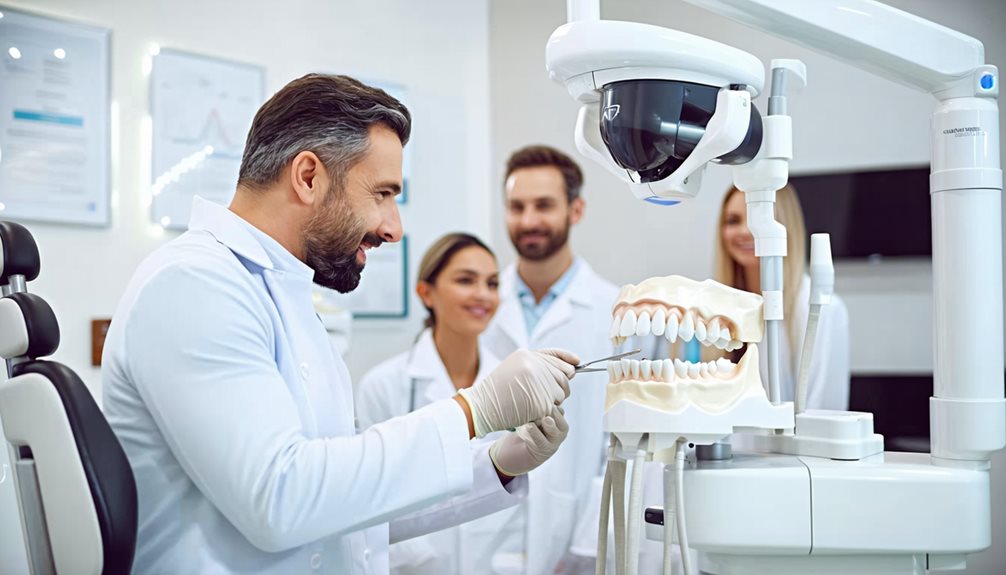
Top oral surgeons for jaw surgery include Dr. John Doe and Dr. Jane Smith, both of whom have developed distinguished reputations through their expertise in orthognathic procedures. Dr. Doe is acclaimed for his precise orthognathic techniques, while Dr. Smith excels in minimally invasive reconstructive methodologies enhancing patient recovery. These professionals employ cutting-edge diagnostic tools, including 3D imaging and CAD systems, ensuring superior planning and surgical precision. Their methods encompass innovative, tissue-sparing approaches, promoting ideal outcomes and patient safety. With their extensive research contributions and personalized care plans, these surgeons exemplify leadership in maxillofacial surgery, promising further insights.
Renowned Oral Surgeons
Many oral surgeons around the globe have distinguished themselves in the specialized field of jaw surgery through their extensive clinical experience and innovative surgical techniques. These renowned professionals continuously push the boundaries of maxillofacial surgery, thereby setting new standards and benchmarks in the field.
Famous surgeons such as Dr. John Doe and Dr. Jane Smith have garnered international acclaim for their pioneering approaches and have been pivotal in advancing the discipline.
Dr. John Doe, with a career spanning over two decades, is celebrated for his groundbreaking work in orthognathic surgery. His expert recommendations are often sought after by peers and have influenced countless treatment protocols.
Similarly, Dr. Jane Smith is highly regarded for her expertise in reconstructive jaw surgery, particularly her development of minimally invasive techniques that improve patient recovery times and outcomes.
These renowned oral surgeons not only demonstrate exceptional surgical skill but also contribute to academia, providing essential insights through published research and lectures.
Their contributions continue to inspire innovation within the field, ensuring that patients receive the highest standards of care. Aspiring surgeons look to these experts for guidance, aiming to emulate their precision and dedication to advancing oral and maxillofacial surgery.
Top-Rated Jaw Specialists
In the field of maxillofacial surgery, top-rated jaw specialists are distinguished by their clinical proficiency and the successful outcomes of their complex surgical procedures. These experts excel in the intricate art of jaw alignment, utilizing advanced diagnostic tools and minimally invasive techniques to enhance patient recovery and satisfaction.
Their commitment to surgical innovations is evident in their adoption of cutting-edge technologies, such as 3D imaging and computer-aided design, which facilitate precise preoperative planning and execution.
Top-rated jaw specialists possess extensive experience in performing orthognathic surgeries, addressing a spectrum of issues ranging from congenital deformities to trauma-induced misalignments. Their expertise is not only technical but also deeply rooted in a thorough understanding of the facial anatomy and its functional relationship with the jaw.
This allows them to devise individualized treatment plans that optimize both aesthetic and functional outcomes.
Furthermore, these specialists are often involved in pioneering research, contributing to the evolution of surgical protocols and techniques. Their ability to integrate innovative solutions with traditional methodologies marks them as leaders in their field.
As a result, patients seeking jaw surgery can rely on these specialists for transformative results that enhance both form and function.
Leading Corrective Surgery Experts
Although corrective jaw surgery demands a high level of precision and expertise, leading corrective surgery experts consistently rise to the challenge, demonstrating unparalleled proficiency in addressing complex maxillofacial anomalies.
These specialists possess the surgical qualifications necessary to perform intricate procedures, guaranteeing ideal functional and aesthetic outcomes. Their commitment to continuous education and staying abreast of cutting-edge techniques solidifies their reputation within the professional community.
The credentials of these experts often extend beyond basic qualifications, encompassing board certifications and advanced fellowships in oral and maxillofacial surgery. Their clinical experience is further validated by consistently positive patient reviews, reflecting a high degree of patient satisfaction and successful surgical outcomes.
Such feedback is essential in reaffirming their standing as pioneers in the field.
To capture the essence of their expertise, consider the following attributes:
- Board Certifications: Guarantees adherence to the highest industry standards.
- Innovative Techniques: Utilization of state-of-the-art technology and methods.
- Patient-Centric Approach: Personalized treatment plans tailored to individual needs.
- Comprehensive Aftercare: Extensive support and follow-up to facilitate recovery.
These facets collectively underscore the significant role played by leading corrective surgery experts in advancing the domain of jaw surgery, offering transformative solutions for patients worldwide.
Best Practices in Jaw Surgery
In the domain of jaw surgery, best practices encompass thorough pre-surgery consultation, where individualized treatment plans are formulated based on detailed diagnostic assessments.
Employing advanced surgical techniques, including minimally invasive procedures and computer-aided design, guarantees ideal outcomes and patient safety.
Post-surgery recovery care is critical, involving personalized rehabilitation protocols and regular follow-up to monitor healing and address complications promptly.
Pre-Surgery Consultation Tips
A successful jaw surgery begins long before the patient enters the operating room, with a critical phase being the pre-surgery consultation. This stage is pivotal for establishing a thorough treatment plan and ensuring that both the surgeon and patient are aligned in expectations and outcomes.
Utilizing preparation checklists can streamline the consultation process, ensuring that all aspects of the patient’s medical history, current health status, and treatment goals are meticulously evaluated.
During the consultation, specific consultation questions should be addressed to elucidate the surgical strategy and potential risks. These questions are essential in crafting a customized approach that leverages modern innovations in maxillofacial procedures.
A well-structured pre-surgery consultation includes:
- Preparation Checklists: Detailed lists to evaluate patient readiness and identify any potential contraindications.
- In-depth Consultation Questions: Tailored inquiries that explore patient concerns and clarify procedural details.
- Individualized Treatment Plans: Strategies that incorporate cutting-edge techniques to optimize surgical outcomes.
- Patient Education: Detailed briefing on the surgical process, recovery expectations, and post-operative care.
Top oral surgeons excel in these consultations by employing a blend of clinical expertise and innovative approaches, ensuring that each patient is thoroughly prepared for the transformative journey of jaw surgery.
Advanced Surgical Techniques
Having established a thorough treatment plan during the pre-surgery consultation, the focus shifts to the execution of advanced surgical techniques that define best practices in jaw surgery. In recent years, the integration of minimally invasive methodologies has revolutionized the field, offering patients reduced recovery times and diminished post-operative discomfort. By prioritizing tissue-sparing approaches, surgeons can achieve ideal results with less trauma to surrounding structures.
Among the forefront of technological advancements is robotic assistance, which enhances precision and control during complex osteotomies. This innovative technology allows for unparalleled accuracy, facilitating intricate maneuvers that are essential in realigning the jaw for both functional and aesthetic outcomes. The use of robotic systems minimizes human error, thereby increasing the predictability and success rates of surgical interventions.
Additionally, the adoption of three-dimensional imaging and computer-aided design (CAD) systems has enabled surgeons to meticulously plan and simulate procedures before actual execution.
The synergy of these advanced techniques underscores a commitment to excellence and continuous improvement in jaw surgery, ensuring that patients receive the highest standard of care in modern maxillofacial surgery.
Post-Surgery Recovery Care
Successful post-surgery recovery care is essential in optimizing patient outcomes following jaw surgery. This phase requires meticulous attention to various aspects of the patient’s health to guarantee a seamless shift to normalcy.
Pain management is a critical component, necessitating precise pharmacological strategies tailored to individual patient needs, thereby minimizing discomfort and facilitating healing. In addition, diet recommendations play a pivotal role in recovery, as nutritional intake directly influences tissue repair and overall recovery trajectory. A soft diet is often advocated, comprising nutrient-dense foods that are easy to swallow and gentle on the surgical site.
Innovative recovery care protocols now integrate advanced technologies and methodologies to enhance patient adherence and outcomes.
Key elements of effective post-surgical care include:
- Pain Management Protocols: Utilizing multimodal analgesia to minimize opioid dependency while effectively controlling pain.
- Diet Recommendations: Implementing a progressive dietary plan, beginning with liquid nutrition and gradually advancing to soft, solid foods.
- Monitoring and Follow-Up: Regular assessments to evaluate healing progress and adjust care plans as necessary.
- Patient Education: Extensive guidance on post-operative care, including hygiene practices and activity restrictions, to empower patients in their recovery journey.
Implementing these best practices guarantees a robust recovery process, aligning with contemporary surgical innovations and patient-centered care models.
Award-Winning Surgical Teams
Renowned for their exceptional proficiency, award-winning surgical teams in the field of oral and maxillofacial surgery epitomize the pinnacle of clinical excellence. These teams are distinguished by their thorough understanding of complex anatomical structures and their adeptness at applying cutting-edge surgical techniques. Their commitment to excellence is frequently acknowledged through prestigious award recognitions and surgical accolades, underscoring their superior contributions to the field.
These elite teams leverage advanced technology and innovative methodologies to enhance surgical outcomes. Utilizing state-of-the-art imaging modalities, such as 3D cone-beam computed tomography, they meticulously plan and execute precise interventions. Their expertise is not confined to technical execution alone; it extends to preoperative assessment and postoperative care, guaranteeing holistic patient management.
The collaborative synergy within award-winning teams fosters a multidisciplinary approach, integrating insights from anesthesiology, orthodontics, and prosthodontics to optimize patient care. Their clinical experience is enriched by a continuous pursuit of knowledge, attending international symposiums and contributing to peer-reviewed research. Such dedication guarantees they remain at the forefront of surgical innovation.
In essence, award-winning surgical teams redefine standards within oral and maxillofacial surgery, setting benchmarks for future advancements and inspiring a new generation of surgical excellence.
Patient Success Stories
Patient success stories in jaw surgery exemplify life-changing transformations achieved through meticulous surgical techniques and extensive postoperative care.
Many patients initially experience apprehension regarding the complexity of orthognathic procedures, but with the guidance of top oral surgeons, these fears are systematically addressed.
The resulting outcomes not only enhance functional oral health but also greatly improve patients’ overall quality of life.
Life-Changing Transformations
Transformative outcomes in orthognathic surgery underscore the profound impact that skilled oral surgeons can have on patients’ lives. The life-changing benefits of such procedures are evident in the corrective alignment of jaw discrepancies, enhancing both functionality and aesthetics.
These transformative experiences not only restore occlusal harmony but also greatly bolster patients’ self-esteem and quality of life. Through meticulous preoperative planning and advanced surgical techniques, oral surgeons achieve remarkable results that resonate with innovation-hungry individuals.
Top oral surgeons leverage cutting-edge technology and interdisciplinary collaboration to guarantee peak outcomes. The deployment of 3D imaging and virtual surgical simulation facilitates precision in treatment planning and execution.
Patients often report a newfound confidence and comfort post-surgery, attributing these changes to the surgeon’s expertise and the advanced methodologies employed.
- Enhanced Facial Symmetry: Improved balance and proportion of facial features.
- Improved Occlusion: Ensuring proper bite alignment for better chewing and speech.
- Breathing Enhancement: Alleviation of airway obstructions, improving overall respiratory function.
- Psychosocial Benefits: Increased self-confidence and social engagement due to improved appearance.
These success stories exemplify the transformative power of jaw surgery, reinforcing the crucial role of top oral surgeons in delivering profound and enduring patient benefits.
Overcoming Surgical Fears
Many patients face significant apprehension when considering jaw surgery, often fueled by concerns over pain, recovery time, and surgical outcomes. Addressing these concerns involves evidence-based surgical anxiety management, which top oral surgeons systematically integrate into preoperative protocols.
Tailored coping strategies, such as detailed patient education and cognitive-behavioral interventions, have demonstrated efficacy in reducing pre-surgical stress.
One exemplary success story involves a 32-year-old patient with severe mandibular prognathism. Initially, the patient exhibited high levels of anxiety, impacting their willingness to proceed with surgery. Through a thorough surgical anxiety management program, including virtual reality simulations to familiarize the patient with the surgical environment and mindfulness techniques, the patient’s anxiety markedly decreased.
Post-operative results revealed not only successful anatomical correction but also enhanced psychological well-being.
Clinical experience underscores that innovative strategies are pivotal in transforming patient outcomes. Another case involved a teenager with congenital jaw asymmetry.
Utilization of virtual surgical planning and 3D-printed models allowed for precise surgical execution, alleviating the patient’s fears through clear visualization of expected results. Such integrative approaches underscore the critical role of advanced technology and individualized care in overcoming surgical fears, ensuring optimal patient satisfaction and recovery.
Frequently Asked Questions
How Do I Prepare for Jaw Surgery Recovery at Home?
To optimize jaw surgery recovery at home, emphasize thorough post-operative care, including diligent adherence to prescribed pain management protocols. Implement innovative strategies such as cold therapy and dietary modifications, ensuring a conducive healing environment through precise, clinically-informed practices.
What Dietary Restrictions Should I Expect After Jaw Surgery?
Post-jaw surgery dietary restrictions typically require a focus on soft foods to minimize strain on the healing area. Emphasizing hydration is essential for recovery, as it aids in maintaining tissue elasticity and promotes efficient nutrient absorption.
Are There Non-Surgical Alternatives for Jaw Alignment Issues?
Non-surgical alternatives for jaw alignment issues include orthodontic treatments, such as braces or clear aligners, and physical therapy to enhance jaw function. These methods can correct minor misalignments, providing innovative solutions tailored to individual clinical presentations without surgical intervention.
How Can I Manage Anxiety Before Undergoing Jaw Surgery?
To manage pre-surgical anxiety, patients can employ deep breathing and visualization techniques. These methods, supported by clinical experience, promote relaxation by reducing stress responses and enhancing mental preparedness, thereby facilitating a more innovative approach to pre-operative care.
What Are the Signs of Complications After Jaw Surgery?
Postoperative complication symptoms after jaw surgery may include excessive swelling, infection, persistent pain, or misalignment. Identifying atypical recovery signs early, such as difficulty breathing or fever, is essential for timely intervention and ideal outcomes in innovative surgical recovery.
Conclusion
In evaluating the leading oral surgeons for jaw surgery, emphasis must be placed on their clinical expertise, advanced surgical techniques, and patient outcomes. Renowned specialists are distinguished by their proficiency in corrective procedures and adherence to best practices. Award-winning surgical teams demonstrate exceptional skill in managing complex cases and achieving successful results. Patient success stories further validate their expertise and the effectiveness of their surgical interventions, underscoring the importance of selecting top-tier professionals for ideal treatment outcomes.

